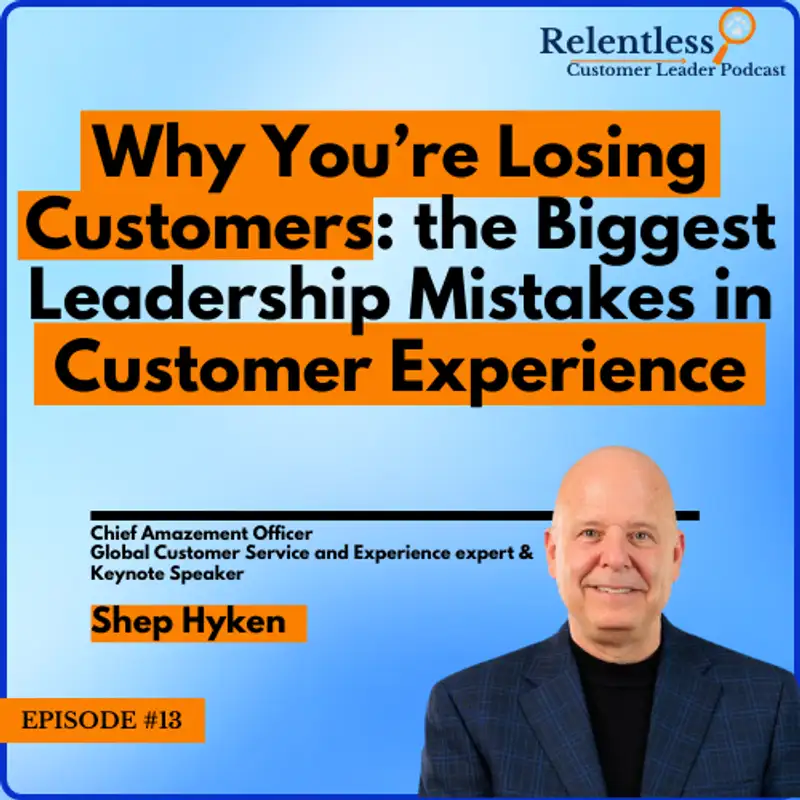
Why You’re Losing Customers: Shep Hyken Reveals the Biggest Leadership Mistakes in Customer Experience
Dr Chris L. Brown (01:01)
All right, well, welcome everyone. We're here today with a very special guest, Shep Hyken. And Shep's someone that I've followed for a long time, actually, your workshop in customer service in particular. And it's evolved over the years through the many, many books that you've written. And I've been a long time subscriber to your newsletter as well, The Shepard Letter. So a big fan of yours. And this is exciting for me to have the opportunity to meet you and
talk with you about your work and how that relates to what we do as well. So welcome.
Shep Hyken (01:35)
Well, thank you. Great to be here. Excited. I'm on the other side of the world. So as we record, it's breakfast time for you, dinner time for me.
Dr Chris L. Brown (01:44)
Yes, indeed. The wonders of technology, You're tired, but you still have got all the energy that you're well known for, so appreciate that.
Shep Hyken (01:46)
You're starting the day and I'm tired.
You should see me early in the morning.
Dr Chris L. Brown (01:56)
You know, so you've spent a long time in this industry and when you think about, guess, what have you seen change in the last 20 or 30 years in terms of working in customer service and so on? What sort of changed?
Shep Hyken (02:08)
So I'm going to give you two answers to that. The first is nothing has changed. And I'll tell you why. and this goes all the way back to the very first complaint ever made in the history of mankind. Customer had a problem. They reached out at the company. They went and resolved at the end. Hopefully they were happy. That's what it was like back then. That's what it is today. And that's what it's going to be like 500 years from now. What has changed is how we go about it. So.
if that makes sense. And I think it's important to understand that there's a big difference. We have an outcome that we want to achieve. How we go about it, it doesn't really matter as long as when the customer is finished, they'll use those three words that I love that were ⁓ coined by the Austrian philosopher Arnold Schwarzenegger who said, I'll be back. That's what we want our customers to say. yeah.
Dr Chris L. Brown (03:00)
Yes.
Shep Hyken (03:01)
And I think that we go about that today with digital solutions, self-service, large language model type of chat GPT fueled chat bots, which by the way, whenever he thinks of self-service, that's where they immediately go to the reality of it is that's a small part of digital self-service. There's many different ways we can approach getting our customers information quickly without them having to pick up a phone, being put on hold, authenticated if necessary.
and spending a lot of time when they could easily get things done on their own. So that has what's changed, the methodology, but the overall reason we do it hasn't.
Dr Chris L. Brown (03:29)
Yes.
Yeah, the fundamental reason, right? And what do you think, what do most leaders get wrong about this area of customer service, do think? What are the sort of pain points that you see in terms of working with different companies and observing that?
Shep Hyken (03:55)
Yeah, gosh, that is a huge question. So I'm going to give you, we'll riff on it. And I'm probably going to give you a number of different answers. the first is many companies. Well, we have to understand our customers and our customers don't compare us to direct competition anymore. They compare us to the best service experience they've ever had. And that means even if you're a restaurant, you might be compared to
mean, here in the US, when I ask my audiences and actually around the world quite a bit, who's your favorite company to do business with? What do you think the answer is? I bet you know. It's not a trick question.
Dr Chris L. Brown (04:36)
Your most favorite company to do business with? Often, mean, the people that I think of straight away are companies like Apple. I mean, I'm a big Apple fan.
Shep Hyken (04:43)
Boom, Apple,
Amazon, Apple, know, two, they're in like the top two or three all the time. So here's what happens. You're in the restaurant, the hotel, or you're in a manufacturing business. It doesn't matter. Your customers, even if you're in the B2B world and you're dealing with vendors, know, vendor relations and procurement people, we're all consumers. So we base our benchmarks of what we want on the best experiences we've had.
Now, here is where to your question, where some leaders get it wrong. They try to improve and they actually do improve. What they have is better this year than last year. But guess what? It's still lagging behind what customers and consumers are ⁓ benchmarking with in their mind. This is what I think a great experience is. There's a number of clients. I'm amazed at the number. I don't know if it's true or not, because it's not my research.
Dr Chris L. Brown (05:30)
Yeah.
Shep Hyken (05:41)
But somebody told me that 50 some odd percent of companies still aren't in the cloud in their customer support. How can that be? The cloud is so much less expensive than the expensive software and hardware and rooms and real estate we have to have to manage all of that. And I think what happened is when somebody built something several years back and it cost a lot of money, they still haven't recouped or at least they don't feel they've recouped the investment in the meantime.
Dr Chris L. Brown (06:00)
Okay.
Shep Hyken (06:10)
They're losing customers and it's costing them market share because they're not up to date. So I think there is a mistake that's being made. I think there's another
mistake of not understanding what your customers want. There's a disconnect. I just recently was contacted by a client about a concern they have that they've missed because of supply shortage and the raw materials that they have. They're manufacturer and they've struggled to be able to make on time arrival.
So many of their customers are starting to look at other vendors to back them up. And you know, that's a very dangerous place to be when you start having, you know, vendors going, you know, I better make sure I have a backup in case you fail me. That's not good. Well, what's happened is he, and the gentleman said to me, we're going to really ⁓ figure this out. We're going to benchmark with NPS net promoter scores. I can't imagine anybody doesn't know what that is, but just in case on a, the question is on a scale of zero to 10.
Dr Chris L. Brown (07:03)
Okay.
Shep Hyken (07:06)
What's the likelihood that you would recommend us? And that measurement gives you the idea, know, yeah, overall they're happy. They might be willing to recommend. I, at CSAT type questions where they ask, you know, were you happy with this? Were you happy with that? I would say those are important, but to this guy, the problem isn't that it's trust. Their customers no longer trust this company and they got to regain that trust. So a trust metric becomes really important.
Dr Chris L. Brown (07:25)
Yeah.
Shep Hyken (07:33)
So I suggested we go out and ask the clients or the customers of this client, do you trust us? And we came up with several questions that would answer that. And before we get the answers back from the customers, we should take leaders and managers and
Dr Chris L. Brown (07:41)
Hmm.
Shep Hyken (07:49)
ask what they think. How on a scale of one to 10 or zero to 10 or whatever, how much do you think our customers trust us? Here's what they're going to see. A big gap, a Delta, a disconnect, if you will.
And I think even in customer service, do you think we provide great customer service on a scale of one to 10? Tell us what you think. And a leader will say, we give a nine or a 10. Customer says they give us a six. So this disconnect is often there. Not always, but it's there. And we want to narrow that gap, if not eliminate it altogether. So those are just a few things where I think leaders are disconnecting with the whole idea of what customer experience is and how customers perceive the experience to be.
Dr Chris L. Brown (08:14)
.
Yeah, yeah, there's a real gap, isn't there, often in perceptions, right? And I think you had some conversations also with one of our business partners, Lyndon, a few weeks ago about some of the tools that we use, our MRI, which is that internal
Shep Hyken (08:42)
Yes.
Dr Chris L. Brown (08:47)
Yeah, look, a couple of comments on what you talk about there. think something that resonates with me also is that this idea of divine discontent. And I think Jeff Bezos talks about that a bit, the fact that customer expectations keep rising all the time, don't they? And so he's sort of chasing that.
Shep Hyken (09:03)
They do.
Dr Chris L. Brown (09:05)
And they're being set by these different experiences that you have, which make it challenging for businesses to keep up and to keep sort of.
Shep Hyken (09:11)
And,
by the way, Jeff Bezos is probably one of the most brilliant people in the world when it comes to understanding the customer experience. That's why so many people say, you know, Amazon or Apple. And here in the U S we do this consumer research every year, and you'll recognize many of these names, Amazon, Walmart, Target, Apple. These are, I don't know, I would assume there's Walmarts over. Yeah. Yeah. So these are world recognized brands, Google.
Dr Chris L. Brown (09:32)
Yep.
Shep Hyken (09:40)
⁓ and then I'm looking at some of the others, FedEx here in the U S I know you get FedEx packages over there. AT &T major, you know, provider of, of broadband services, which I'm surprised they showed up in the top 25, by the way, not AT &T per se, but anybody in that, in that industry, cause they've usually taken hits. but these are recognizable brands. And what we asked was if you.
Dr Chris L. Brown (09:51)
It's.
Yeah. Yeah. Yeah.
Shep Hyken (10:06)
When you think of great service experiences, tell me your three favorite brands that come to mind. So we literally got 6,000 entries to look at and thanks to AI, I was able to quickly summarize those into the top 25 and categorize them. Actually, we did the top 100, categorize them. And we also took a look at the differences in the demographics because Gen Z is completely different than a baby boomer.
Dr Chris L. Brown (10:32)
Mm-hmm.
Shep Hyken (10:36)
And it's important to understand who your customers are overall. And by the way, that's another interesting, going back to your question about, there sometimes where do leaders or companies make mistakes? If I, ⁓ I'll give you an example, very generic example. If I'm a retailer and I'm targeting a younger audience, that audience that I'm targeting right now is one day going to age out of whatever it is that I sell. The option I have is to try to keep them as customers.
Dr Chris L. Brown (11:01)
Yep.
Shep Hyken (11:04)
or recognize, no, no, they're no longer the customer we want. That's also an issue. Do we really want to keep certain customers? you know, and by the way, the goal would be to attract new ones. And I have clients like, you know, ACE Hardware, by the way, Mitre 10, who's over in your part of the world. I've done a lot of work with them and I met them at an ACE Hardware event when I guess because they do some joint venturing with them.
Dr Chris L. Brown (11:14)
Yeah.
Shep Hyken (11:28)
And one of the things was fun for me to learn is that they try, they they want young people. When I say young kids, like 10 years old to fall in love with ACE hardware. Because if we can make them love going to the hardware store to buy their tools, it doesn't matter what age they are, but we've got to do it young. So they have birthday parties and things too, where, know, you build projects and it's a fun birthday party. Guess what happens?
the rest of their life, all they do is think about the best hardware store in the world is the one where I went to when I was a kid. yep. And by the way, you only keep that customer because you gave a great experience.
Dr Chris L. Brown (12:01)
Yes, yes, yeah, yeah, absolutely.
Yeah, yeah. Well, they're connected for life. They've had great experiences. They're emotionally connected to the brand, right? They have a relationship. Yeah.
Shep Hyken (12:15)
Great word. That's
what you want. The word emotionally connected because without emotion, you cannot have loyalty. You might get repeat business without emotion, but emotional connection, and I'm assuming it's positive emotion. You're be angry at a company too. We won't go there.
Dr Chris L. Brown (12:30)
Yeah. It could be the other
way. Yeah, yeah. No, they're great examples. And, you know, I spent quite a bit of time shipping California, about 16 years. And so I had the ACE hardware experience, I sort of really enjoyed them and had the experience of them really looking after you when you come in, right? They're very focused on people walking in the door and making sure they get what they need when they're in that environment. And we have something similar down here. have a
a chain called Bunnings. I don't know if you've heard of them before, but they do an incredible job down here in Australia, I think, of really, you know, making sure that the customers looked after when they come in and they find what they need in this complex sort of massive hardware store, right? So, they're great examples. Probably shifting gears a little bit, when we think about sort of customer service versus sort of a broader idea that we talk about is customer culture.
across the business. How do you see those two sort of concepts? mean, are they related? What's been your experience?
Shep Hyken (13:34)
One cannot be successful without the other. And so I thought you were going to go customer service versus customer experience. Service is interactions and that type of thing with people. And that's what most people perceive service to be where experience is everything. But to the point of culture, without the right culture, none of this works. Maybe you're lucky that a few people are a department or
If you're a chain of something, you know, certain managers or leaders of whatever the locations are, are more successful than other because they're more customer focused. When we sit down with a client and probably 85 to 90 % of our clients are already doing well, they're either wanting to stay at the top of their game, they're looking over their shoulder and they're seeing companies starting to catch up with them. I'm working with a retailer coming up. They have about 400 locations.
And I said, you're rated number one in the entire United States, yet you're upset because you said you're losing ground. And they said, yeah, our customer satisfaction scores are dropping, even though we're still number one. Well, what does that mean? Eventually somebody is going to catch up, right? They are so focused internally on making sure the culture is one that drives that experience. So when we sit down with a client, we say,
And by the way, if there's a real problem, we start with the culture and the leadership. But if there's not a problem, we still want to say, tell me about your culture. Tell me what's ingrained. You've got mission, vision, value type statements. Where is the customer service angle within these? So what we'll do with the client is sit down and we have a six step process. Real simple, I'll go through it. We define what the experience is supposed to be.
And it's usually a one sentence definition of what we're trying to achieve. And underneath that, have what I refer to as non-negotiable behaviors. This is what has to happen to achieve this overarching North Star. Sometimes it's in the vision and value and mission statements, and we just find it and pull it out and tighten it up. Other times we help them write it and create it for them. But it needs to be there. It needs to be short enough, one sentence, so everybody can remember it.
Then we start training to the behaviors and tactics to go to that. So we start with creation of the mantra. That's what I call it, that one sentence. We discuss the communication rollout, figure out that plan. We train everybody on what their
Dr Chris L. Brown (15:55)
Okay. ⁓
Shep Hyken (16:02)
role is within this plan. We ask that leaders become the role models and demonstrate how these behaviors are exhibited, these tactics and non-negotiables.
⁓ We ask leaders, managers, supervisors, anybody that has somebody working for them to defend that culture by making sure if somebody's out of alignment, they bring them back in, they train them, they spend more time with them, they do whatever. And number six is if it's all working, just let them know it's working and delight in it and celebrate the success. So define it, communicate it, train to it, be the role model. So I guess demonstrate it.
Dr Chris L. Brown (16:36)
Yep.
Shep Hyken (16:43)
defend it, and then delight in it.
Dr Chris L. Brown (16:45)
Yeah, yeah, that's a great model. It's a great process that you're taking people through to really make it part of the culture, right? Part and actionable. What's... yeah, yeah, that's right. It's like, no, no. That's right, that's right. You know, I'm a big fan of doing Iron Man triathlons and...
Shep Hyken (16:55)
Yeah, sounds simple, doesn't it? Yeah, but not easy. Remember that simple is not easy.
Dr Chris L. Brown (17:06)
You know, it sounds simple on paper, right? You just go for a swim, you go for a bike ride, and then you go for a run. But yeah, it turns out to be a little bit more challenging that, but that's great. Yeah, look, in thinking about your work in that area, Shep, I mean, how have you, you know, the sort of natural personalities perhaps that are more focused on customers and...
Shep Hyken (17:09)
Yeah.
Dr Chris L. Brown (17:30)
and helping people. And then there are others that are great technically maybe, and they're very good at certain jobs. How do you engage some of those other sort of styles of people in the organization to really come along this journey? you had some experience in sort of bringing people along that way?
Shep Hyken (17:46)
Yeah, it's,
there's one word that comes to mind and it's adaptability. ⁓ we have to recognize, and I think part of your work probably falls into this. you understand the behavioral styles of the different leaders, the different employees, the different team members that you have and realize there's only, it depends on what you use, but really there's not that many behavioral styles that you would have to adapt to. I've got somebody that might be very outgoing and gregarious.
Social, I'm probably more of that. And then you've got somebody that's really introverted. Well, you can put them into a job and they will either fail or succeed based on their personalities because some people are just not built for that type of job. Doesn't mean they don't have an important part of the customer experience. A numbers person, somebody that's very technical, numbers oriented, who works in the finance department, may be very introverted and uncomfortable going out on a sales call.
But if a customer called and had a problem in understanding an invoice or there was a question about numbers, they could shine in how well they helped that person. And by the way, if I took a salesperson and stuck them into the closet and said, you got to file this huge stack of files, it would be a matter of a very short time before they imploded because they need to be out amongst people. ⁓
Dr Chris L. Brown (18:53)
Yeah.
Yes.
That's right. That's right. And that's why there's such a challenge, I guess, with these sales sort of pipeline systems and getting sales reps to put information into the right. That's a well-known... Yeah.
Shep Hyken (19:15)
Right. It's just, like, I want to just move on. So adaptability
and being able to take what you have and adapt it to the personality and behavioral style and recognize that this person is this way. And when you understand that you communicate with them differently than you might someone else. And as a result, they're more fulfilled and happier in their jobs and willing to do that little extra and maybe go outside of their comfort zone for you on occasion.
Dr Chris L. Brown (19:41)
Yeah, yeah, absolutely. It's been interesting in the work that we've done, Shep, we've found that people that have this orientation to be really customer centric are across the organization. So they can be in finance and they can be in IT. They can be in sort of these more technical functions, typically. And so part of it is unleashing that capability with them and sort of giving them permission, I guess, to
to be a little bit more customer centric in terms of how they do it. And it might be a bit different, as you say, depending on the personality, how does that actually show through? What does that manifest itself in, in terms of how they behave? Yeah. Yeah.
Shep Hyken (20:18)
Right? And training, training them is different. If you train one type
of a person versus another, you may be looking to reach the same goal, but you've got to train them differently. You know, I work with a group of IT folks on a number of occasions I've had this happen and we do the behavioral styles. We know exactly how they're going to turn out, but now we need to teach them how to talk to human beings that aren't so technically oriented. And it's a lot of fun to see it.
Dr Chris L. Brown (20:28)
Yeah.
Yeah, yeah.
Shep Hyken (20:43)
come to life and like the light goes on and go, wow, I'm actually having a better relationship with somebody that I've never been able to talk to because I understand how to communicate better.
Dr Chris L. Brown (20:54)
Yeah, yeah, no, absolutely, absolutely. That's significant challenge. know, one of the other sort of ideas that comes up often is this idea of should we be customer focused or employee focused? And what's the sort of balance across those two things and which comes first? know, should we be customer focused and then employee focused? What are your thoughts on that idea?
Shep Hyken (21:21)
Well, I think that's
great question. First of all, should we customer focused or employee focused? The quick answer is yes. But which comes first? That's the right question. ⁓ Herb Kelleher, who started Southwest Airlines here in the US, was once asked a question. Who's more important, passengers or the employees or even the stakeholders, the people that invested the money?
Dr Chris L. Brown (21:31)
Yeah. Yep.
Shep Hyken (21:47)
And when he was asked that question, he wasn't exactly sure if he had the right answer, but it turned out to be the right answer. said, I think if we focus on taking care of our people, the employees, they will be happy and they'll want to take care of customers better. The customers will be happy with how well they're being taken care of. And guess what'll happen then? More people fly on us and it's going to make the stakeholders happy. So it really wasn't, he called it a conundrum. It wasn't a conundrum at all.
Dr Chris L. Brown (22:03)
Thanks. Okay.
Shep Hyken (22:15)
He said, it really
turned out to be the right thing. You can't, and one of the things I talk about in a lot of my speeches is what I refer to as the employee golden rule. You know, the golden rule that we grew up learning is to treat people the way we want to be treated. Well, how about we treat the people we work with the way we want our customers treated? If we treat them that way, maybe even better, it just transfers to the customer. So your question, which comes first? Employees.
Dr Chris L. Brown (22:31)
Good.
Yes, yep.
Mm.
Shep Hyken (22:43)
I do believe you have to think with the end in mind. We've got to think of what success looks like. Are we going to sell out of the product? Are they going to like the product? Are we going to take care of the customer? And once you establish what those goals are, you start on the inside and work your way out.
Dr Chris L. Brown (23:00)
Yeah, yeah. It's a real symbiotic sort of ⁓ relationship, isn't it, between this? Because, know, often, mean, a lot of the work that we will do is transformational work around, so, you know, customers aren't happy anymore, for some reason, right? What's underneath that? Well, you know, the satisfaction levels are going down. Well, yeah, often it's because we don't have the environment to enable
Shep Hyken (23:04)
Mm-hmm.
Dr Chris L. Brown (23:25)
the employees to deliver a good experience, right? And so that's where it becomes, okay, we've got to start internally and think about how do we create an environment for these people to provide the feedback to leadership that's necessary to actually create a new customer experience. And a lot of that sort of insight comes from employees, doesn't it? I they're on the front lines, working with people, they're seeing it, and it's giving them the opportunity to actually feed that back in a way that allows that
the leadership to empower them to actually create great customer experiences.
Shep Hyken (23:57)
So while we're talking, I just pulled up an article that is going to be released next week, my newsletter, and it's titled this, anything that is immediately gratifying will be repeated. Steve Wynn, who created and built the gambling empire with the Wynn, the Encore, and he's all over the world, this is how he opened his speech, and this was 15 years ago.
Anything that is immediately gratifying will be repeated. And he went on to say the strongest force on earth is something that affects your self-esteem. So he started talking about complimenting employees and doing the type of thing. And he came up with the idea, we've been doing this for even longer than that. We've been working with clients on having people tell their stories and share their stories of when they created great experiences for customers or guests or patients, clients, whatever you want to call them. So
he went on to say that there was an employee that did something above and beyond. And so he challenged everybody to find an opportunity for them to write up an example, all employees of the above and beyond that they did for either an internal customer, a fellow employee, or an external employee. And that was a great idea. But here's what he said at the end of the speech, which I think is also really important.
Let's see, he said somewhere here. have it. But basically he was, he was saying we can spend a lot of money on chandeliers and marble and onyx. I have it here. It's in a quote. I'm just trying to read it real quickly. ⁓ Anyway, the bottom line was, I don't care how nice that and expensive that, that renovation or that upgrade is, if the employees aren't there to support it.
Dr Chris L. Brown (25:29)
Yeah.
Shep Hyken (25:41)
So I always write, if you receive my newsletter, you know I write, I do a cartoon every week. So I'm going to tell you what next week's cartoon is going to be. A fancy hotel with shiny marble floors and a chandelier and a very dapper dressed hotel manager says to a guest, don't you love our hotel? We just spent $10 million on upgrades and renovations. And the guest says, I don't care if you spent a hundred million, you didn't hire the people who were friendly and helpful. I'm not coming back. So,
Dr Chris L. Brown (25:42)
Yes.
Yeah.
Shep Hyken (26:11)
The point is you can't out-decorate poor customer service, and the most impressive upgrade is hiring and training great employees.
Dr Chris L. Brown (26:19)
Yes, yes, yeah, absolutely. mean, and that's what we experienced, don't we, is we experienced that engagement with the staff, right, of these places. I mean, that's really what these organizations about. Sometimes they forget that actually they're, you know, that's just the scaffolding, isn't it? That's the environment, which is important as well in different circumstances. But I think it's really the people and the engagement that you feel from
Shep Hyken (26:30)
Right.
Dr Chris L. Brown (26:48)
from an experience of interacting with them is what's gonna make you continue to work with them or not. Yeah.
Shep Hyken (26:56)
There's a bit of a balance.
The product has to do what it's supposed to do. It needs to meet an expectation. So if it's a hotel and you want to spend $50 on a hotel or whatever low-end hotel, you're going to get a low-end hotel from the standpoint of amenities. Small room, you know, maybe not the, I don't know, not a huge room, old towels, I don't know, but...
Dr Chris L. Brown (27:12)
Yes. Yeah.
Shep Hyken (27:20)
If you spend a lot of money, you can get a fancy hotel. But here's the thing. I stayed at one of these lower end hotels one day and I wrote an article about it. And if you to take the people who worked there, the front desk, the housekeeping and transfer them to the most luxurious hotel, they would be superstars. And that's why I love the hotel. Their idea of breakfast was, you know, a microwave sandwich from the freezer. But you know what? The way they delivered it with such happiness, it was so nice and pleasant.
Dr Chris L. Brown (27:45)
Thank
Yeah.
Shep Hyken (27:50)
that it's like, wow, I want to come back because
of the people, not because of a microwave sandwich or because of a smaller hotel room. You know, I want to, love the people. And by the way, I got a nice night's sleep and the room was clean and you know, really what else was I after? ⁓ So, but if I'm going to take my wife on a luxury vacation, I'd probably stay somewhere a little bit more expensive. And maybe my expectation of the employees might be a little higher.
Dr Chris L. Brown (28:07)
Yeah, yeah, yeah.
Shep Hyken (28:18)
because I am spending more money. However, me, I personally think money doesn't make a difference, whether it's inexpensive or very expensive, inexpensive or very expensive, whatever it is you sell. Customers deserve to be treated with the right dignity, respect, and the utmost care, friendliness, and helpfulness that goes along with
Dr Chris L. Brown (28:41)
Yeah,
yeah, no, absolutely. You know, one of the challenges in this space is that a lot of what we talk about are intangibles, they? They're sort of experiences that are not easy to sort of quantify and so on. How do you think about measuring sort of ROI and return on some of this work? There's no doubt that comes up often when you're engaging clients.
Shep Hyken (29:05)
Right. So many customer satisfaction metrics can be gamed. So we need to get a real metric. How are we being treated or how are we being rated by our customers and how we're treating them? I think it's really important to understand that and also understand what would happen if we incrementally raise that number. Let's say on a scale of one to ten, we were an eight. What would happen if we were nine? Well,
There's a lot of research out there that says as you start to raise those customer satisfaction numbers and Fred Reichald, when he came up with the net promoter score, said that an incremental increase in your net promoter score, the likelihood that a customer would recommend, you recognize, if they're going to be one of the people that would recommend us, they're a rock star. By the way, he now says, that's a great measurement, but the real question after you find out whether they're likely to recommend,
is to find out what percentage of your customers coming in, new ones, are from referrals from existing customers. That's how you know you're really strong. ⁓ But I think what you asked about was ROI. And that's what, when I first read that book many years ago, probably in the 1990s, he wrote The Loyalty Effect, or the only question you'll ever need to ask, something like that. Anyway. ⁓
Dr Chris L. Brown (30:13)
Mm.
Mm-hmm.
Yes, yes.
Shep Hyken (30:30)
He talked about these incremental percentages yielding a higher, exponentially higher number in ROI. I get that. Here's the one thing we do know, that customers that do come back on average, spend more money than every once in a while types of customers or first time customers. So we know that getting them to come back is better in the long run. It's typically far less expensive to create the experience that gets them to come back.
than it is to go out and market, advertise, and spend the money to get them to come in the first place. I just read an article, ⁓ and I'll probably include it in my top five roundup that I do every week, that talked specifically about how advertising dollars are nowhere being spent or nowhere near as successful in how they used to be compared to creating the experience that gets people to come back and talk about you and create word of mouth advertising.
I will argue that customer, people say, well, customer service is just answering complaints and answering questions. No, that's customer support. Service is much broader than that. It's every interaction your customer has with your company. And by the way, if it's a digital experience, that falls into the customer service role. Customer experience, as I mentioned earlier in our conversation, is much broader than that. So when we start to look at that,
and analyze what does it cost for us to create an experience that gets the customer to come back again and again. It's probably far less than what it costs. Well, I know it is because of all the stats in general, but it's far less expensive than to try to recruit a new customer. And by the way, we should never stop trying to recruit new customers, but let's create the experience where customers talk about us and bring in the new customers for us in addition to that.
Dr Chris L. Brown (32:12)
Yeah.
Shep Hyken (32:20)
There's a ⁓ major restaurant chain worldwide. I don't know today if they still do this, but back when it was run by Tom Baldwin, he was the CEO at the time of Morton's Steakhouse. And they have Morton's all over the world. And he said, we don't advertise. don't, we don't put ads in newspapers and magazines. The best advertising is that customer that keeps coming back and bringing their friends or talking about the experience they had. And I just love that. You know, if you can get away with that.
Dr Chris L. Brown (32:43)
Yeah. Yeah.
Yeah.
Shep Hyken (32:47)
you're
in a very, very good position.
Dr Chris L. Brown (32:49)
Yeah, it says a lot about really the, you know, the resonance of the offer and the experience around the offer with the customer, doesn't it? And it sort of reminds me, I do a fair bit of work with startups and, you know, those types of organizations. There's this concept, this product market fit concept in the startup world. And there's a metric that sort of, you just prompted me that came to mind, which is ⁓ Sean Ellis has this measure of
Shep Hyken (33:05)
Mm-hmm.
Yep, I know Sean.
Dr Chris L. Brown (33:17)
you know, the measure. it's to do with the fact that you're trying to understand, you know, if I took this service or this product away from you, how unhappy would you be really? And you kind of want sort of, you want a large percentage of your customers to be very unhappy with that because, you know, because it's something that they really, you know, are getting value from, they like, they're talking about it, they're, you know, there's positive word of mouth, all of that sort of stuff.
Shep Hyken (33:30)
Yeah.
Dr Chris L. Brown (33:45)
It's not a bad measure for existing businesses, right, as well, to get some insight.
Shep Hyken (33:48)
Yep. That reminds
me of the new Coke. Remember when Coca-Cola released the new Coke? How upset the customers were? Bring it back! And they did.
Dr Chris L. Brown (33:54)
Yes, yeah, yeah, yeah, yes,
yeah, yeah, that's right. Exactly, exactly. ⁓
Shep Hyken (34:03)
But by the way,
even in the manufacturing business, this is even more important. I should manufacturing in the B2B world. It's so much more important manufacturing. How many, if I walk into a mall and I want to buy a sweater like this, I can probably find 15 stores in a large mall that would sell me a sweater, but there might be only 15 companies that make create and sell what I sell in the B2B world worldwide. So if I lose a customer to one of my 14.
Dr Chris L. Brown (34:28)
Yeah. Yeah.
Shep Hyken (34:32)
15 other competitors, boy, what's the likelihood that I'm to be able to get them back? Well, it's much easier when there's a broad, broad number of choices and more consumers than ever buying that. So we have to be very, very careful, especially in niche businesses where, and specifically the B2B world, where we could lose a customer for years and years before we have a chance to get them back again.
Dr Chris L. Brown (34:56)
Yeah, yeah, they're gone for a long, long time, aren't they? You've written a lot about sort of amazing experiences, right? And, you know, there's sort of this, probably a tension between delivering an amazing experience, but then also you've also written about just doing the fundamentals right and making it easy for customers. How do you think about those two concepts and maybe the trade-offs?
Shep Hyken (35:17)
So making it easy,
making it easy is different. But ⁓ the fundamentals of a great experience or being amazing, amazement comes from meeting expectations consistently because most companies can't. if I am always, if the word always is in front of, I'm for my clients, for them to say to me, he always gets back to me. He's always helpful. He's always knowledgeable.
He's always friendly. When I got a problem, I know I can always count on him. When a customer says that about the companies they do business with, that word always in front of anything lets you know that there's this consistency. Consistency is amazement. That's what it equals. You know, they're amazing. They never let me down. They may not ever have to go over the top either to do that. Once in a while, companies will do that. So that's important. Now, convenience.
Whoa, that's a whole nother level. Pre pandemic, believed that one of the biggest, and I still believe it today to be true for a short period of time after the pandemic, we were forced in the pandemic to become more convenient for customers. By the way, when it comes to delivery and that type of thing, we went off the charts as far as we gained five to seven years of experience in this real short period of time.
when customers couldn't come to our stores, we had to deliver to them. If I wanted to sell somebody a car, they couldn't come to my showroom, I would have to bring it to them. Well, customers started getting used to that. But just prior to the pandemic, I wrote a book about convenience. And it was really interesting as I look at my annual customer service research, convenience is the number one thing customers look for in a company. If you make it easy for me, I might sacrifice friendliness.
I might sacrifice, I'll definitely pay more, okay? I'll pay more for convenience than I will even more for good customer service. So making it easy on me is really important. I joke about certain airlines, it's like, you know what? If you were able to guarantee that if I was on your airline and you would always be on time and never cancel a flight other than a weather or mechanical delay, not operations type issues.
Dr Chris L. Brown (37:11)
Yeah.
Mm.
Okay.
Shep Hyken (37:32)
If you, because I do not want to be in the air when they find out there's a mechanical, I'd rather be on the ground. But if you promised me, I would always get there on time. I would, I don't care how you treat me. I'd pay more money for it. You know, those kinds of promises. And that's, that's convenience because unfortunately, it's really amazing to me. go on to, ⁓ certain airline sites and they will tell you, you know, this flight is only on time, you know, 81 % of the time. That means one in five times. It's not going to make it. I'm going to wow.
Dr Chris L. Brown (37:37)
Yeah.
Yeah. Yes. Yes. Yeah.
Hmm. Hmm.
Shep Hyken (38:01)
what flight
does get there. And I look earlier in the day for that same route and it's like, okay, they're only late 3 % of the time. Well, that's the one I'm take. I want you to think, are you married? Do you have kids? Okay, so when your wife, yeah, so when your wife's having the baby, she's not going to the OBGYN that one out of five times drops the baby. I mean, that's what the airlines are saying when we're not gonna make it, know, when we're on time, barely 80 % of the time. So 20 %...
Dr Chris L. Brown (38:09)
Yes.
Yes, yes, no kids but married.
No. No.
Yeah, yeah, no, absolutely.
Shep Hyken (38:31)
We miss. That's a lie.
Dr Chris L. Brown (38:33)
Yeah, yeah, yeah. No, look, I know that we're short of time, Shep, and I think we could probably talk all day about this topic. ⁓ I know you could.
Shep Hyken (38:39)
All day. I just start reading
some of these books I've written behind me and I just, I'm just kidding.
Dr Chris L. Brown (38:45)
Yeah.
What's one sort of piece of advice, I guess, that you would leave with listeners around sort of making progress on this area in their organization?
Shep Hyken (39:00)
⁓
I'll give you two or three ideas. The first ties to exactly what you do, and that is focus on the culture first. This whole thing that we've talked about is not so much tactical. It starts out philosophical. And then you design tactics and behaviors around it to drive it. So I have always said customer service is not a department. It's a philosophy. Same thing with experience. It's a philosophy to be embraced by everybody from the CEO to the most recently hired.
So make sure when you hire somebody, they align with what you're trying to achieve. That's number one. Number two, if you haven't done it, figure out what all the touch points are. Journey map, which is an old term, but I think it's powerful to recognize what all your touch points that you have with your customers are. So once you identify what all those touch points are and the inside operation that drives those touch points, that's very important.
So, ⁓ would do that. And then I would teach everybody in the organization that at any given time, they are responsible for the reputation of that brand. call it the CEO of the moment, especially on the front line. If a customer is interacting with anybody in the company, that person right at that moment is representing everything about that company. When the customer hangs up, are they going to say, and this is what customers say.
I love doing business with them and they fill in the blank. Why? Well, them was a he, she, or however they want to identify they, who took care of them, that customer. So them is often not plural. It's a singular person. And so everybody should recognize they have this amazing responsibility to always be on their game when it comes to interacting with people. So we start with the culture and that philosophy.
Dr Chris L. Brown (40:35)
Yeah. Yeah.
Shep Hyken (40:51)
We recognize every touch point and find ways to improve on those touch points if possible through the journey mapping exercise and get everybody to do their job and become your brand ambassador.
Dr Chris L. Brown (41:02)
Yeah, that's fantastic advice, Shep. Thank you. Thanks so much. Where can people find you and your work? What's the best way to engage with the learning? Yeah, yeah.
Shep Hyken (41:05)
My pleasure. Thank you.
everywhere. Just go online and look for me. But if you go to hyken.com,
h-y-k-e-n dot com, you can subscribe to the newsletter, which is free. And also my annual research is there. You just click on it. You don't even have to give me your email address. It just comes to you directly. So that's free as well. And ⁓ yeah, there you go.
Dr Chris L. Brown (41:27)
Fantastic, Yeah.
Thank you, Shep. Well, thanks so much for taking the time. It's been fun to talk to you. I really enjoyed it and I'm sure we'll do it again sometime.
Shep Hyken (41:39)
I look forward to that. Thank you very much. Can't wait to come back.
Dr Chris L. Brown (41:42)
All right, thank you.