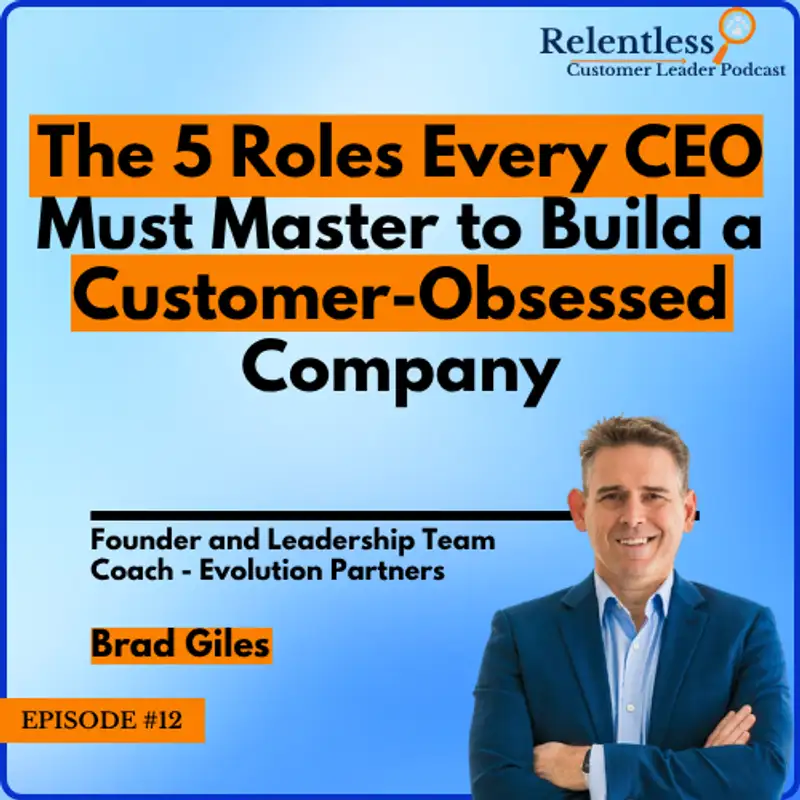
The 5 Roles Every CEO Must Master to Build a Customer-Obsessed Company - Insights from Brad Giles
Dr Chris L. Brown (00:00)
So I'm here with Brad Giles today and Brad and I were introduced by a friend of ours, Darren Holland, ⁓ who is someone that speaks very, very highly of you, Brad. And he's a guy that's certainly been an exceptional CEO himself. ⁓ And as part of that process, I got introduced to your book and your work and I was...
became fascinated with the model that you've developed and also sort of how it relates to some of the work that we do. Because there's a lot of sort of similarities in terms of how you can apply this model to create a really customer-centered organization. And so your book's called Made to Thrive. And I thought we could sort of, as part of this conversation, start off with, you know, what was the origin of that book? Where did that come from for you? Was there sort of a...
a spark that sort of lit the fuse that decided that, you know, I need to write a book on this leadership stuff and how to make great CEOs.
Brad Giles (01:01)
Yeah, thank you. Yeah, this was my first book. ⁓ I've now written four, but this was my first book. And it was born of absolute ⁓ frustration, I think, and and seeing a lot of people wasting their effort. ⁓
So the opening in the book is, I'm going to misquote myself, but words to the effect of every leader's challenge is how to make their effort count for the most. And, and so what I saw is this wasted effort and it really came about because people didn't know the role of a CEO. Now I'll use that in the context, perhaps not of a Coca-Cola or a Pepsi-Cola size conglomerate, but, more.
the everyday kind of operational type CEO in a mid market to maybe larger business. But people didn't really know the role. They know what a nurse does. They know what a doctor or a carpenter or other professions do. You can say that. But when you say, well, what's the role of the CEO? What are they supposed to do? There wasn't really a book that I could find that articulated that. And so
I needed to help people and I got quite frustrated because I couldn't point them to a book and that was really the genesis of it.
Dr Chris L. Brown (02:28)
Yeah, yeah, there wasn't not a good structure. It's kind of a loose sort of ⁓ role, I guess, in many ways for people particularly coming into it. And I imagine with the businesses that you're working with, you know, there isn't a lot, maybe not a lot of structure around those roles as well. So just being able to define that. And that's something that you talk about a lot ⁓ in your model as well, in terms of defining different roles and people knowing what they're responsible for and what their roles about to you.
Brad Giles (02:55)
Yeah, the working title was the five roles of a CEO. And then I kind of evolved and thought about that. ⁓ To your point, but but yeah, we don't really know. And, I guess, I guess
we talk about the results of a CEO when we think about the role. So we think, well, what does a great CEO do? And then so we might logically go to, well, the results of a great CEO is that they ⁓ produce a good profit, healthy profit higher than you might expect, or depending on the corporate structure, they've added market cap or share price or something like that. But...
what if they're set in fire to the balance sheet when they're doing that? Or what if their attrition is 50 % or 80 %? ⁓ And so that's not really the true measure of a CEO, because there's nothing enduring or sustainable about it. Anyone can, and there's been numerous case studies of leaders who've jumped in and created one measure of success, but that it hasn't.
exceeded in the long term or hasn't been an enduring positive effect. And so it really began the journey into well, what are the results of a great CEO and how do they create them?
Dr Chris L. Brown (04:13)
Yeah, and so the the books framework is really designed, you know, to push leaders from good to great to push them out of their comfort zone, isn't it? And what are sort of, I guess, some of the symptoms that you see in businesses? Are there some sort of common patterns in working with organisations where there's sort of symptoms that typically they're weak in one or another? Is there a common pattern or is it sort of
Brad Giles (04:21)
Yeah.
Dr Chris L. Brown (04:43)
across the board in terms of.
Brad Giles (04:44)
Yeah, well, anecdotally, I think that it depends on the personality of the leader. ⁓ And, and that's why the diagnostic which we can jump into or not is designed in the way that it is. So I don't think that that it's uncommon that
people who come from, let's say, a more of a sales background, for example, might be focused on sales when they're in the leadership role because it's their domain expertise and they're probably more interested in it. And then they might leave some other areas of, let's say, the role or things that need to be done to other people. But when I look at the five roles, ⁓ which are accountability,
ambassador, culture, strategy, and succession planning, you might have leaders who are very good at culture, but not very good at accountability. Or you might have leaders who are very good at being an ambassador, going out there and promoting the company to employees and stakeholders, but they might not be very good at other things. it really to
your question, it really comes down to the personality of the individual and what's their background, what are they interested in, but really trying to strip that away and say, well, what are the results that we need?
Dr Chris L. Brown (06:20)
Yeah, yeah. And so the personality certainly comes into it, doesn't they have a certain bent towards maybe one of those roles more than another. then it's a matter of how do you balance those things out? You mentioned that accountability sort of is one of the key elements of the model. ⁓ And about sort of having these clear KPIs for employees and partners and so on. In a customer obsessed organization, ⁓
How do you think about ⁓ accountability as a capability that enables that? Is that something that ⁓ you see a relationship between those two things?
Brad Giles (07:03)
I ⁓ KPIs are the bread and butter of anyone who works in a B2B capacity with businesses. They're necessary. You don't want too many. You want the right ones, but they've got to be useful and they've got to be ⁓ actually something that works. ⁓
So there's no doubt that people can come in to any organization. They can introduce a whole range of KPIs in whatever format works, but they've got to be a system that the organization utilizes and is valuable to the people, not just a bureaucracy. ⁓ And, and that really, helps us to understand if the people are performing their role. So to your point about being a customer obsessed organization,
We still need to know whether we're performing. How does the organization make money? ⁓ It serves customers well, to use a phrase. ⁓ And that is great. And some people are accountable for components of that, if we break that down. And there needs to be a level of understanding, measurement, accountability around those aspects, as well as other aspects.
Dr Chris L. Brown (08:26)
Yeah, you one of the things that's interesting for us in our work is that often you'll have parts of the business that's customer-insessed and delivering a great experience, maybe, you know, at the sales and marketing front end, but then other parts of the business that also have an impact on that customer's experience of the organization and whether or not it's delivering, maybe less so.
And so that was where I was sort of seeing some connections potentially in how do you actually ⁓ engage other parts of the business to actually deliver on a great customer experience, which when I think about your model and the strategy piece is really about having a value proposition that's unique, that's differentiated, having an ideal customer and so on. But then it's a matter of how do you actually mobilize the organization to do that effectively.
Have you seen any in your work ways in which accountability can be used sort of inside the business ⁓ around other functional areas to help them sort of understand how their role drives that sort of, that customer value proposition, that experience at all?
Brad Giles (09:42)
⁓ I suspect it might be more cultural in my experience. And specifically, this book is about the five roles of a CEO. So how to get outside of your leadership comfort zone. ⁓ We want the business to have a strategy, the strategy must create a unique and valuable position in the market that is different from the competitors, such that you can organically grow your ⁓ gross profit.
dollars margin as appropriate over time because you're adding more value to the customer. So strategy is about the value chain and the customer, no doubt. But in my experience, the accountability is the mechanism, the jigsaw pieces that come together to get people to focus on the right things. And then from a cultural lens,
is the way that we, who we are and our perspective toward customers and then through the core purpose lens is why we exist. So that would translate very practically in our lens in a customer obsessed organization is our purpose is to help our customers to do X, Y, Z or to free customers from the burden that is ABC.
Dr Chris L. Brown (11:08)
Yeah, yeah. Yeah, I think it's interesting, isn't it? The cultural piece, just this idea of this is just the way we do things. We look after customers, right? It's just part of how we do things. And it's sort of to me, I've been reflecting on this and thinking about the accountability piece. And, you know, in some ways, you know, I've seen two different ways in which leaders do this. One way would be sort of a fear based thing. Look, you have to look after customers.
Brad Giles (11:19)
Yeah.
Dr Chris L. Brown (11:38)
It's sort of a fear-based sort of ⁓ accountability to some extent to say, look, make sure you look after customers and so on versus the cultural piece being maybe more of an intrinsic sort of way of drawing out that natural motivation to actually do the right thing by someone else or by customers.
Brad Giles (11:56)
And that's a really interesting point, because what that makes me think about is net promoter score. I'm assuming that everyone's heard of NPS or net promoter score. Simple question. How would you rate your experience with Brad on a score of one to 10? And then we determine the detractors and the neutrals being the seven and eights and then the nines and tens of the promoters, the promoters are the people who are likely to promote. And that's all good and well. But then that's what we're calling net promoter score two, according to Fred Reichelt.
from Bain who created ⁓ that model. But now they've got Net Promoter 3. And now the reason is that if you're holding people accountable to a number primarily and you're not culturally driving the...
I'll use your phrase customer obsession. People game the system and people employees might say to customers, look, if you give me a 10 out of 10 on this survey, I'll get my bonus or whatever it might be. So it's not about the numbers. It's about the behaviors.
Dr Chris L. Brown (12:56)
Yeah. Yeah.
Yeah, yeah. Now this is it. And we've seen this, Brad, many times, unfortunately, where it is gamed, right? You get a metric and then suddenly, I had this experience in the US, you where, you you go to get your house serviced and they're telling you what number they want from you, because they're bonused on it or they're measured on it and, know.
Brad Giles (13:20)
Yeah.
yeah. And that's the power of Net Promoter Score 3, which I probably didn't explain, but that's based on actual hard dollars. So ⁓ asking someone, am I likely to recommend and is gameable. But when I stop spending money with that company, that's very measurable and very hard. And how do you get a good NPS 3 score? Well, the customer comes back and spends more.
Dr Chris L. Brown (13:49)
Yes, yes, that's the ultimate measure, right? That's the ultimate measure. Yeah, yeah, no, that's great. ⁓
Brad Giles (13:51)
Yeah, for sure.
Dr Chris L. Brown (13:58)
Yeah, the other piece that I found really interesting was this idea of an ambassador, right? The CEO was an ambassador and sort of role model. How do you think about that, the importance of that role as part of the overall model? And what are some examples of that sort of in practice?
Brad Giles (14:21)
⁓ Yeah, it's a good pick up. So I think about in response to the question, what does a company without an ambassador at the helm look like? It's got no soul. It's got no, people are just a number. No one, the customers, the other stakeholders, the employees, no one really knows.
what the company is or what they stand for. There might be corporate slogans, ⁓ but we don't really know what they stand for. So people need meaning in their work and they need...
to know that they're a part of something, especially today, because now the largest cohort in the workforce is millennials who have their own sense of purpose and meaning at work that they feel is necessary and perhaps rightly so. And so...
It's not that we need to go out being to use an Australian example, ⁓ Jerry Harvey from Harvey Norman, we don't need to be plastered all over adverts and have our face on every single thing. It's more about utilising your style, your personality, what you're comfortable with, but understanding that the absence of an ambassador in a leader is a great detriment because people
need to feel like they're a part of something like the purpose is meaningful. And that there's something authentic about that. And what happens when we've got a good and strong ambassador ⁓ within the business? yes, in the Jerry Harvey from Harvey Norman, I'll just explain a famous Australian retailer ⁓ in in
Without the external even, what happens is it positively affects the people and the team, the ambassador role, and it leads to a higher percentage of top performers and a higher retention within the organization.
Dr Chris L. Brown (16:34)
Yeah, yeah. They really bring the energy to the organization, don't they, in their own way, and really sort of stand for something, I guess, right? That's sort of the role of that ambassador is to sort of say, this is what we're about, and this is why we're here.
Brad Giles (16:50)
What's one of the many tools to unlock pride? Okay. Now you, you need to, it's, I will emphasize it's got to be authentic. Okay. And it's got to be you, but if there was no ambassadorial activity whatsoever. there was no talking to employees, for example, about the, the, the, the strategy and the plan and the core values and the purpose and a lot of these kinds of things, people will just tend to.
get on with it and feel like they're treated like a number and consequentially act like they're a number.
Dr Chris L. Brown (17:28)
Yeah, it takes sort of the human out of the business or the sort of humanity out of business in some ways, right? Where ⁓ it becomes a job, not sort of a calling or, you know, you can't get the best out of people without that. Yeah.
Brad Giles (17:45)
Yeah. And,
you know, we're in a war for talent. So the best people will begin to look elsewhere. And hence the retention comments earlier.
Dr Chris L. Brown (17:53)
Yeah.
Yeah, yeah. The other thing that has always fascinated me and I think I mentioned to you before we started the podcast, was listening to one of your podcasts, ⁓ you and Kevin talking about values in businesses, As many of us have seen, we walk into an organization and there's a fantastic look of sort of aspirational values up on the wall and, ⁓ you know, we're
Brad Giles (18:07)
Yeah.
Dr Chris L. Brown (18:25)
We're customer focused, we're a great place to work, et cetera, et cetera, whatever they've got on their walls. What's your perspective on the use of values in organizations where there is that disconnect between what's on the wall and perhaps what they're trying to achieve? And how do you look at that whole process?
Brad Giles (18:53)
I'll start with a story. I have a slide in the work that we do with leadership teams. There's one particular slide that comes to mind when you ask me that. And it's a set of core values for an Australian company that you would have heard of, but which will remain unnamed. And they've got 21 core values, right? And...
Dr Chris L. Brown (19:16)
Wow, okay.
Brad Giles (19:18)
So they don't stand for anything, right? We typically say three to five, if you got seven, all right, you can arm wrestle me into that. Not that it's my thing, but it's, it's going to be authentic. It's got to be who you are and what you stand for. So like showing this slide, you know, month after month, quarter after quarter, and eventually I show it. And one of the leaders sort of recoils a little bit and they say, I actually used to work for that organization. And I was like, ⁓ I'm in trouble here. And so she said,
When we were there, there was a merger and acquisition. We acquired this other company. The CEO of the other company said, I'm not gonna not have my values. I'm wedded to them, that's who we are. We love them, they've gotta be there. And so what the first CEO did was merged them in and went from, let's say, seven to 14.
Then they acquired another business and the other leader saw what had happened and heard that and said, well, I'm not, I'm not going to leave my values. We've got to merge them in as well. So what eventually happened was they had so many core values. They couldn't remember what they are. No one else could remember what they are, what they are. And they were completely useful and, and, and essentially a point of mockery. ⁓ so, so it's got my point there is it's got to be authentic and.
Dr Chris L. Brown (20:35)
Yeah.
Brad Giles (20:42)
they're a qualitative way to know the line that we're not going to walk past. They really say, you know, what do we stand for? And when you connect and think about that in terms of culture, and you think about the ambassadorial role, which is helping people to understand what we stand for, like who are we? What do we stand for?
it's a really, really important role. Everyone has sat next to or worked alongside people who are, I'll use the phrase toxic for want of a better term, but they might be producing the numbers. They're consistently ⁓ producing the KPIs that we want, but no one wants to talk to them and sit next to them ⁓ because they're not culturally aligned or they breach.
regularly the core values of the organization and what we kind of stand for. unless you have some guidance around what that means ⁓ and it's really at a DNA level understood by everyone, it can be really challenging.
Dr Chris L. Brown (21:51)
Yeah, it's really interesting in the work that we've done. So businesses will come to us because they're not really delivering for customers for one reason or another, They're flatlined or they're stagnated or they're getting a lot of customer feedback that's not great. So they've decided, well, we want to do something about it. And our approach to it is to look at their culture, essentially.
Brad Giles (22:04)
Yep.
Dr Chris L. Brown (22:20)
and understand really are they a company that wants to put customers first and really deliver a great experience or not. And they might have this value that says customer focus or whatever, but they're just not delivering on it, right? It's not part of who they are really. It's just a thing on the wall. And so, and I know that you do this also, but this idea of connecting the values then with the behaviors, right? So whatever that value is, what is, so, okay, we say we're customer focused. What does that translate to?
Brad Giles (22:34)
Mm.
Yeah.
Dr Chris L. Brown (22:49)
translate into in terms of how we're dealing with customers.
Brad Giles (22:53)
Yeah, and that's the qualitative and quantitative aspect because it's very hard for leaders to manage against core values. So if we've got a customer which, sorry, if we've got a core value, which is we love the customer just to pick something random.
If you're a manager or a mid-level manager who sees that value and you can see a direct report to you who isn't meeting that, it's quite hard to turn the qualitative into something measurable that you can talk to them about.
And so that's where we've got core values and then core values are made up of the behaviors under that. And that's a series of that. What we would advocate is two to five specific statements, helping people to understand what that value is. So we've got the value and typically we'd have an explanation going back to the example, love the customer. We look after the customer. We make sure that their needs are met, whatever is the subsequent explanation, but then there's another body.
of work, which is we always and we never, and that's what we call behaviors. So we always get back to customers in 24 hours, quantitative, right? And that's what a manager, that's a tool that a manager can use that is so much more effective than the tool for ⁓ just saying we always love the customer.
Dr Chris L. Brown (24:20)
Yeah, because it's not actionable or sort of you can't hold anyone accountable directly to that, right? Whereas you can to the behavior. Yeah, yeah. That's a great example. The last part of your model there is succession planning, which in my experience anyway, is something that I don't see a lot of businesses doing really well. What's been your experience in that sort of world?
Brad Giles (24:27)
Totally, totally.
Yeah. ⁓ I think first of all, I've got to explain what succession planning is because listeners will think, so that's about the next in line to take over the role or the business. ⁓ So is your son going to work in the business or your daughter type of thing? It's not that it's about reducing key risks, predominantly at the highest level.
so, ⁓ it really came about by my endeavor to reverse engineer great results. So if we go back to the beginning of the conversation, if you only produce net profit, you can set fire to the balance sheet or you can have a terrible culture. So really thinking about that.
and thinking about the model holistically, what we need is the accountability that we spoke about before, that accountability system to be in place, but also this to achieve great results, this succession planning or risk mitigation type.
aspect as well, because you're gonna have the greatest accountability system in the world. And then one of your suppliers will say, by the way, we've shut our factory and you're not getting any equipment and then you won't consistently achieve results, which is one of the five results. So so it's really about making sure that we've got a good level of employees in our system already. And we've got
employees that we can put people into, for example, what we call a virtual bench, you've got a player salesperson or any role, for example, do you what happens when that person resigns? Do you simply go to the market or a recruiter? Or are there people that are already on your virtual bench that you can access so that that that you can say, remember all those coffees that we've had? Well, we've now got an opportunity, we'd love to have you apply.
⁓ and using that in that sense. Again, the second part of that is the products and services. So you've got to really think about what are the risks to our product and services and suppliers. And then having a, terms of risk and succession planning, having a decision-making framework to avoid risk, because ⁓ I think the stats were that I quoted in the book.
⁓ Most managers make decisions based on gut. So a system to make that. ⁓ And then really succession within the business. So if Jody is going on leave or leaves or has a problem, who's going to step into that role?
Dr Chris L. Brown (27:26)
Yeah.
Yeah, yeah. It's really been much more thoughtful about that process and the backup plans, isn't it? For each of the roles that are crucial across your organization. And if you think about your own work with organizations, you know, I know you run a lot of strategic off sites for leadership teams to help them and that sort of thing. What are the...
Brad Giles (27:45)
Offshore.
Dr Chris L. Brown (28:05)
When you engage an organization first, what are sort of the quick wins that you typically look to work with on them to sort of get them going in the most effective and efficient way in looking at their business? I imagine it's going to vary a little bit based on an assessment of where they are, but are there sort of common ⁓ cadences of what they're doing that really make a quick improvement to an organization sort of in the first? ⁓
parts of your engagement with them.
Brad Giles (28:36)
Yeah, great question. ⁓ We do one thing and one thing only. So we don't sell days, we don't do projects. We embed a leadership team coach into a leadership team to ⁓ make that leadership team highly effective and thereby the business highly effective as well. And so yeah, there is only one thing that we do. yes, everyone comes ⁓ with a different
a different type of team, type of industry. ⁓ But generally, it's most of the time, it's in a similar shade. ⁓ so our job is to build a plan that the team believe in that can help them to succeed and get them aligned.
around that so that they've got confidence and clarity that they're working on the right things. So we really embed a full system into an operating system into the leadership of the business ⁓ and make sure that they're able to ⁓ do their best work. Because the biggest challenge
is really around alignment and cohesion. mean, there's data ⁓ out of Harvard that says that about 90 % of employees don't even believe that their company has a plan. So the ⁓ plan isn't the value, it's the planning. It's all of the thinking and the process.
Dr Chris L. Brown (30:14)
Yep, the process.
Brad Giles (30:18)
and then the post, which is the execution of the plan. So we really get all of that stuff to work and work well.
Dr Chris L. Brown (30:25)
Yeah, yeah. So it's a big part of its strategic alignment, isn't it? And just getting people aligned and getting them rallied and heading in the right direction and board into that right direction and putting their energy in that,
Brad Giles (30:37)
Absolutely. remember working with a team in Sydney and it was our first two day kickoff to the objective to build a plan, a one page plan. And I guess the important part is that is not the job of the leader. It's the job of the leadership team. So we're endeavoring to take the weight of that.
decision away from the leader and democratize it for one of a better term, which might not make sense. But the people who build the plan don't fight the plan. And that speaks to that alignment. So I can remember going into a two day planning meeting in Sydney. And I mean, this was a very packed agenda. And we spent the first two hours asking, we talking about company A or company B?
And so trying to figure it out. So that was necessary and a key part of alignment for that team because before that, for years before that, they thought, this is what we do or where we're going or whatever.
Dr Chris L. Brown (31:35)
Yeah.
Yeah, yeah. It sort of reminds me actually, I've been reading a book recently, I'm not sure if you've seen it, a book called Refocus by Dan Heath. You heard of that one? Yeah. There's a great little chart in that actually around, you know, it's the odd four box chart. I think it's got alignment and sort of empowerment on the two dimensions. And it's about crossing a river. And you've got sort of
Brad Giles (31:52)
Yes, it's great. ⁓
Mm-hmm.
Dr Chris L. Brown (32:10)
If you've got low alignment and sort of low empowerment, then people are sort of looking left, right and centre, don't know where to go. If you've got high alignment, then the leader's saying, we need to build a bridge, go and do it sort of thing, just directive leadership. And if you've got sort of low, sorry, high empowerment, low alignment, it's sort of saying, you know, how are we going to get, is anyone taking care of the sort of getting across the river sort of thing, the sort of loose sort of leadership style?
And the best one's the sort of combination which you've sort of described there, right? Where you've got that alignment and sort of like, how are we going to get across the river, right? It's asking that question and being more collaborative and engaging the team in a way.
Brad Giles (32:42)
Yeah.
But it's
also about, it's also about knowing in our role, knowing the answer before you go in and not that it's the right answer or even knowing a multitude of answers and then going in and saying, so it seems like there's a river on our path. Is this a problem? Do we think this is a problem? Do you all agree it's a problem? Okay. What are all of the options that we could do? We could build a boat. We could.
go around the river, whatever it might be. it's getting the team to have the healthy debate. ⁓ The conflict is essential because you can't get commitment until you've had healthy debate and conflict.
Dr Chris L. Brown (33:35)
I thought something that we could talk about also is your new book, which is coming up and it's coming out soon
Brad Giles (33:42)
Yeah, ⁓ so I'm going to take one step back and explain on boarded. How do you bring new hires to the point where they're more effective faster? So the frustration that I spoke about from Made to Thrive, no one knows what a CEO role does. There's no job description you can necessarily go to that makes sense and is validated by logic, let's say.
Within Made to Thrive, the first thing that we spoke about was the accountability role. And within the accountability role, the first part is all employees understand every aspect of what it takes to succeed in their role. So employees have got to understand before you begin to hold them accountable or something. Now, this was the second point of frustration is, well, people don't understand that. We can give them KPIs, we can do this.
There's great hiring systems and there's great hiring system books, but they're about hiring and really the data was overwhelming. And I did ⁓ a research study with over a thousand CEOs and hiring managers around the world ⁓ to get my own data and to validate my suspicions, which were about ⁓ the cost of onboarding is overwhelming.
I'm not a HR expert or a people and culture expert, but I deal with these leadership teams and see this pain every day. ⁓ And so that was the frustration that led to the second book. And then the third book was really the same book, but without the research element and more about this is the book that you hand out to a manager to help them to get why they need to
spend time on an audit onboarding process for 90 days that for their hire they've just hired ⁓ that they don't otherwise think is any value at all and it should be someone else's job. Again, we work in strategy and leadership and planning and building this system. So really then,
The third major frustration ⁓ was people who waste their life. And whilst the first two books, two and a half books were more about these roles, this book that's coming out bigger isn't better, better is better, is aimed at owner led companies. Now, I put it to you that under Steve Jobs,
⁓ Apple was a owner-led company. ⁓ So I really make the distinction between a corporation and an owner-led company. So you've got a significant stakeholder. ⁓ Now, people can get enamored with the idea that bigger is better.
when in actual fact better is better. Very simple to say and you connect your own dots. Let's say you're a $10 million company and you think to yourself, well, if we got to $100 million, that'd be fantastic. Let's build a plan to get to $100 million and then my life will be so much better. But it's never the case.
And I like to say that this book was written with the blood and the sweat and the tears of 25 years as an entrepreneur for me and with all of the teams that I've worked with and the friends that I've had along the way to be fair. And so it really talks about this problem because you are as an owner in an owner led company, you are free. So you don't have shareholders telling the board what to do and the board telling you what to do and holding you accountable.
And equally, you're not a startup where you've got investors who are seeking a ⁓ quick turnaround. So you've got this problem of freedom. And because that offers you so many paths, you can do everything you can do anything, but you can't do everything. And so it really sets out to say, do you want to get bigger with this problem of freedom? Or do you want to get better because better is the life that you really want. And better means
better, a better team, first of all, see having a team with soul and we touched on this earlier on. Second is having better customers. So better customers think long-term value, customer acquisition cost, and also through each of these lenses, what is the competitive advantage that we can create through a strategy lens when it comes to the
natural benefit that we have. And this is drawing back from the ambassador role conversation we had earlier. Then the third one is a better offering. Or what are the hundred little things that you're going to do that other people won't then better financials is the fourth component. But then finally, ⁓ is a better life by design. So there's no point spending the best years of your career chasing bigger.
when you get there, then finding out this is not what I really wanted at all. Now, the irony is it's not about becoming smaller. It's about building a business that compounds. The book is really about the mindset of compounding.
Dr Chris L. Brown (39:08)
Yeah, okay, okay. Now I can see there's a great need for that particularly in today's, I think the noise in the markets always about growth, isn't it? And superhuman growth and you see all these outliers.
Brad Giles (39:21)
Well, Albert Einstein said that the eighth wonder of the world is compounding either you're paying it or you're earning it. And I'm really trying to draw a straight line to that.
Dr Chris L. Brown (39:28)
Yes.
Yeah, yeah, fantastic, fantastic. Well, this has been really a great conversation. It's been great to get to know you a bit more, Brad, as well, and appreciate the time you've taken. Where can people reach you and follow you and your work? What's the best way for them to get hold of you?
Brad Giles (39:50)
Yeah, the best way is our website, evolution partners.com.au. Most people say that best way is my newsletter. for since 2014, every week, I've put out a newsletter. And people joke, that's the best thing about me. Unfortunately, they're close friends as well, which is quite annoying. But in all seriousness, yeah, the newsletter, it's
Dr Chris L. Brown (40:12)
Ha ha ha
Brad Giles (40:19)
I just try to provide three really interesting insights each week. And so that's probably the best way, but we're on LinkedIn and the socials as well.
Dr Chris L. Brown (40:30)
all those places. No, I'm a subscriber and I can vouch for the fact that it's high value, really good content. So definitely encourage people to look that up. thank you. Thanks, mate. Thanks for the time today and we'll see each other again, I'm sure.
Brad Giles (40:41)
Well, thank you.
Thanks